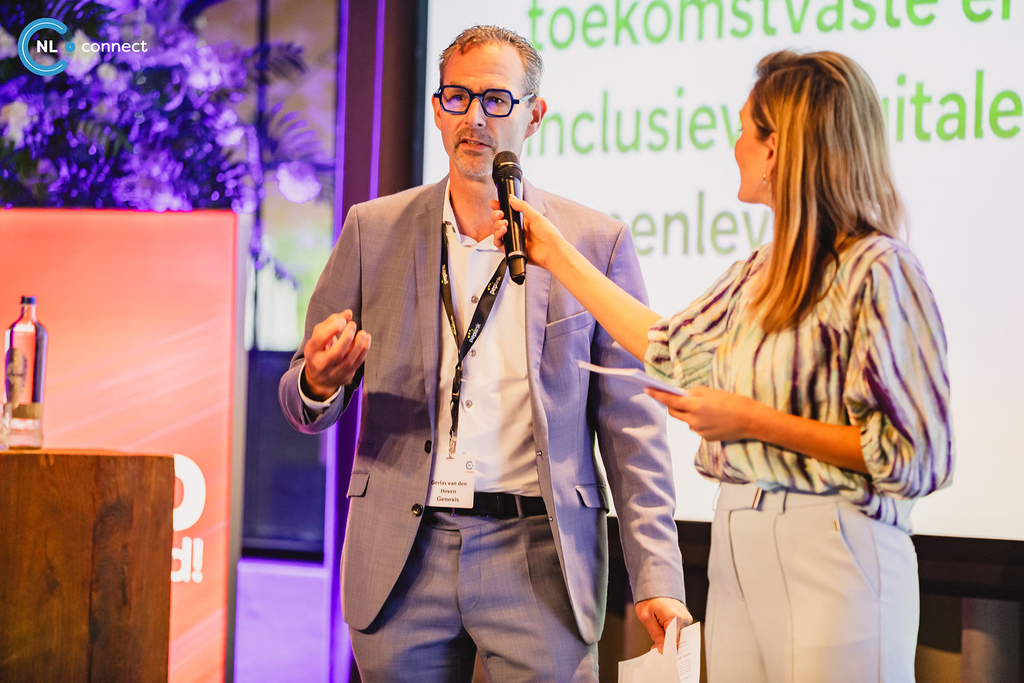
At this year’s NLconnect annual event, the Dutch telecom industry came together around a theme that could not be more relevant: Building trust in a connected world. As Chairman of NLconnect and CEO of Genexis, I had the privilege of opening and close the keynote part, featuring a strong line-up of speakers who each, from their own perspective, showed why trust is becoming one of the most important currencies in our industry.
The discussions moved from resilience and critical infrastructure to quantum security, cyber incidents, digital wellbeing, fiber networks, and phishing prevention. Different topics, but one shared conclusion: connectivity is no longer only about access, speed, or capacity. It is about confidence. It is about responsibility. And above all, it is about our ability as an industry to keep society connected in a way people can trust.
Resilience starts with understanding what we depend on
Ron Roozendaal from the Dutch Ministry of Defence opened with a powerful reflection on the complexity of the world we operate in. His message was both sobering and necessary: when value chains become too fragmented and too much knowledge is outsourced, customers, suppliers, and even governments risk losing the full overview.
He reminded us that resilience is not an abstract concept. It is the ability to continue, to act, and to retain the knowledge and capabilities needed when circumstances change. His example of the Dutch Corona app also showed that openness and transparency can strengthen security rather than weaken it.
What stayed with me most was his image of the cemetery in Kharkiv. It was a deeply human reminder that resilience is ultimately about perseverance, preparedness, and standing together when it matters.
Security must be built into the infrastructure we trust
Phaedra Kortekaas from Eurofiber then took us into the world of quantum technology and Quantum Key Distribution. Her contribution made clear that the future of secure connectivity will not happen by itself. It must be built, protected, and continuously improved.
Her reflections on quantum technology and artificial intelligence were a good reminder that the next generation of digital infrastructure will be shaped by probability, uncertainty, and new forms of intelligence. That makes trust even more important, not less.
Interestingly, quantum technology and artificial intelligence seem to have something in common. Neither is solely about digital ones and zeros. Both involve probability and uncertainty. As she explained, Schrödinger’s cat is no longer just a thought experiment; it is a concept we may need to understand in practice.
Trust is tested when things go wrong
Søren Abidgaard from Odido shared a personal and very open account of the cyberattack on Odido. He spoke with honesty about how the organization responded, where mistakes were made, and how those mistakes were addressed. That transparency was powerful.
His words captured the essence of the day: “We sell trust.” In telecom, that may be one of the most important promises we make. People rely on our networks for work, education, healthcare, public services, safety, entertainment, and everyday life. When the connection is compromised, trust is compromised with it.
He spoke with remarkable openness about how the organization responded, where mistakes were made, and how those mistakes were addressed. His transparency was powerful.
Søren also addressed the digital wellbeing of young people and the StartPhone initiative, launched by Odido and its partners. By adding a protective layer around smartphone operating systems, the initiative helps younger people take more responsible steps in an increasingly digital world. It is a practical example of how our industry can contribute to a healthier relationship with technology.
From building fiber to building differentiation
Joost Steltenpool from Open Dutch Fiber brought the discussion to the evolution of fiber networks. Although his topic was passive networks, there was nothing passive about his presentation. He showed how the major fiber rollout is gradually reaching completion, while the market is entering a new phase.
The challenge is no longer only to build networks. The challenge is to manage them better, create stronger services, and find new ways to differentiate. Future value will increasingly come from innovation, new combinations, and partnerships that help operators deliver more than connectivity alone.
Fighting phishing is fighting for trust
Ako Madomi from the National Cyber Security Centre spoke about the Anti-Phishing Shield initiative, developed together with KPN and the Dutch Police. His figures were striking: one in ten people becomes a victim of phishing. This is not only a financial problem; it is a trust problem.
The Anti-Phishing Shield has already reached approximately 400,000 people and prevented around 4.5 million clicks on domains likely being used for criminal activity. That is impact at scale.
Jim van Zon from the Dutch Police and Dex Maes from KPN reinforced the urgency with a clear message: we cannot afford to be naive. Protecting people online requires collaboration across operators, public institutions, technology providers, and law enforcement. No single organization can solve this alone.
A shared responsibility
My reflection after this event is simple: trust is not something we can claim. It is something we must earn, protect, and renew continuously. As NLconnect, and as an industry, we have a responsibility to act together. We need infrastructure we understand, technology we can rely on, partnerships that strengthen society, and the courage to be open when things do not go as planned.
That is why the theme of the day resonated so strongly with me. In a connected world, we do not only sell products, networks, or services. Together, we sell trust.