Why Europe’s freedom to choose must extend all the way home
Our CEO, Gerlas van den Hoven, reflects on how the European telecom industry is having important conversations about reclaiming our digital sovereignty, and he believes that one of the most important perspectives is right under our nose.
Governments, policymakers, and technology leaders are debating how we can reduce our dependence on non-European technology, strengthen European innovation, and secure our digital future. Much of those discussions focus on big topics such as artificial intelligence, cloud platforms, semiconductors, and data centers. And rightly so. Many of these topics are fundamental to Europe’s competitiveness, security, and independence.
But I believe we’re overlooking something much closer to home.
Digital sovereignty doesn’t stop at the data center. It extends through the entire digital infrastructure, right down to the gateways and routers connecting our homes and businesses.
For Europe’s fiber broadband industry, that raises an important question: Are we building networks that give us genuine freedom of choice, or are we creating dependencies that could limit our options tomorrow?
80%: Europe’s dependency problem goes deeper than we think
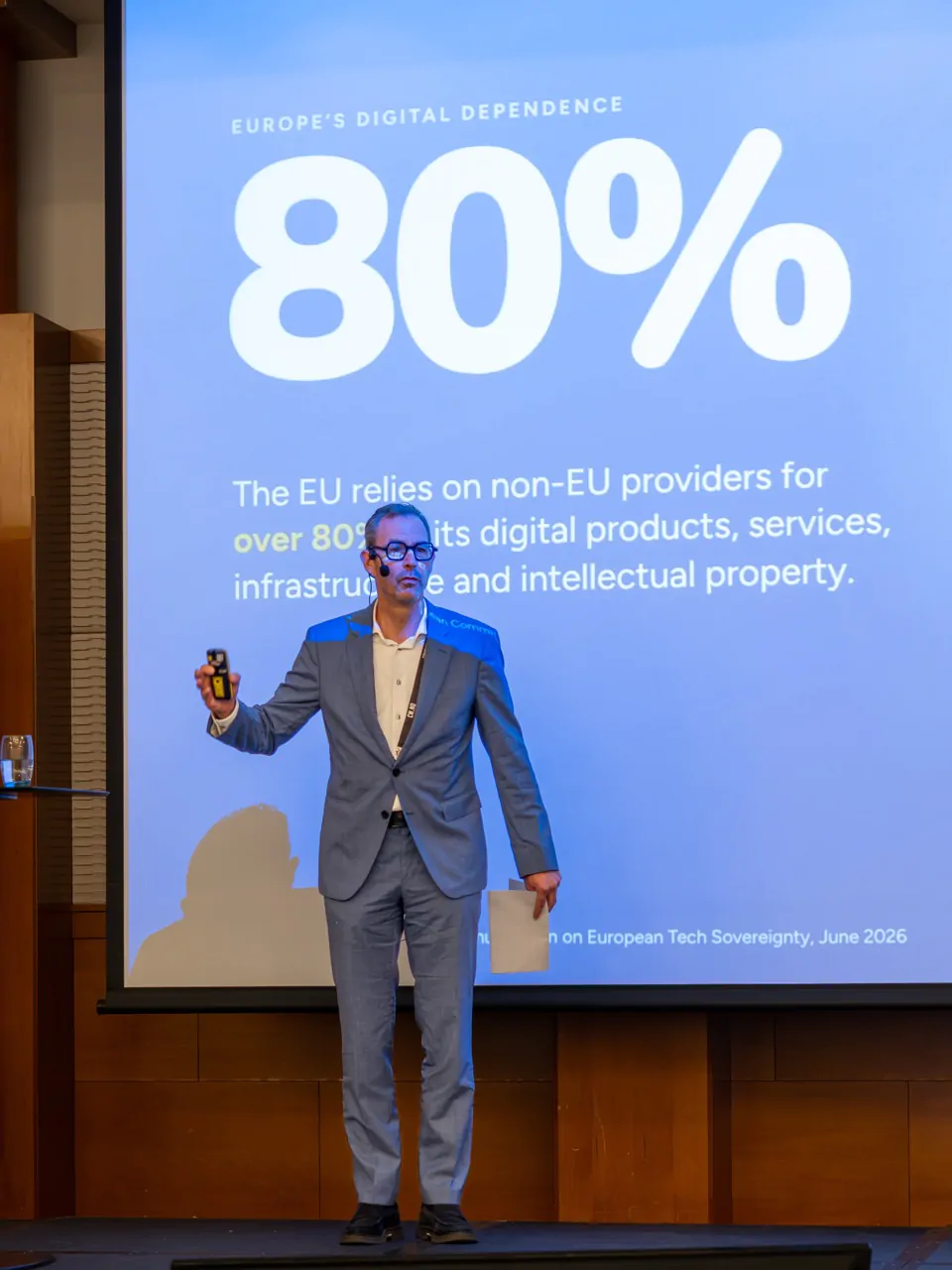
According to the European Commission’s 2026 Communication on European Tech Sovereignty, the EU relies on non-EU providers for more than 80% of its digital products, services, infrastructure, and intellectual property.
That’s a remarkable level of dependence for Europe’s technological ambitions. Moreover, the European Commission’s 2026 technological sovereignty initiatives reflect a growing concern that Europe needs greater control over the technologies supporting its economy and society.
The objective is not simply to bring more tech advancements to Europe, but to strengthen our ability to make independent decisions about the infrastructure and services on which we depend. The Commission describes it in this way, “Technological sovereignty is thus grounded in openness, partnership and fair competition. It does not mean isolation, protectionism, or tech decoupling.”
When we think about critical digital infrastructure, we tend to picture large data centers, undersea cables, and national telecommunications networks. But for most people, their digital world begins with a much smaller piece of technology, sitting right next to the couch at home: the gateway.
According to study from Sovereignty Alliance for European Network Technology (SAFENet), the routers and home gateway devices installed in hundreds of millions of European homes, small and medium-sized enterprises, account for approximately 93% of European internet traffic flows. These devices operate largely outside the EU’s broader sovereignty and supply-chain security framework. Today’s gateways are increasingly sophisticated, software-driven platforms that manage connected devices, optimize Wi-Fi performance, support cybersecurity, and enable new digital services. That makes them an important part of Europe’s digital infrastructure, and a potential point of technological dependence. This raises important questions:
- What happens if a critical component becomes unavailable?
- What if a manufacturer stops providing security updates?
- What if an operator needs to replace a supplier because of new security requirements or geopolitical developments?
- Can the operator adapt without replacing thousands of devices or redesigning significant parts of its network?
These are not hypothetical procurement concerns. They are questions about operational resilience, investment protection, and long-term control. Even more interesting is how we address these concerns.
We cannot build digital sovereignty in Europe’s data centers only to surrender it at the network edge.

Trust is essential. Dependence is risky.
Fiber networks are complex. No operator can realistically inspect every component, review every line of code, or eliminate every external dependency.
We need trusted technology partners. But trust should never become blind dependence.
For me, genuine digital sovereignty rests on three principles: trust, interoperability, and freedom of choice.
At NLconnect’s yearly conference on broadband, the main message was “We sell trust.” That may be one of the most important promises of FTTH. “Are we on Earth to build data centers or are data centers here to help people live their lives? The data center is a tool; the home is the destination,” was how I formulated it at the Telecom World event in Antwerp just last week. It all boils down to the same thing: as the broadband industry, our job is to serve and protect the European consumer.
Another principle for digital sovereignty is open standards and interoperability to enable equipment and software from different suppliers to work together, reducing unnecessary barriers to innovation and network evolution.
A third principle is multi-vendor architecture which provides freedom of choice, flexibility and reduces the risks associated with relying too heavily on a single technology provider. And lifecycle security ensures that responsibility does not end when equipment is installed. Manufacturers must continue to address vulnerabilities, maintain software, and support products throughout their operational lives.
At Genexis, we believe this responsibility extends well beyond the initial sale. Our commitment to open standards, interoperability, and lifecycle security reflects our belief that operators should remain in control of their networks rather than become locked into a particular supplier or technology.

How sovereign is your network?
For operators and ISPs, digital sovereignty should become part of everyday strategic decision-making. It starts with asking some straightforward questions:
- Do we understand where the critical technologies and components in our network come from?
- Who controls our software, firmware, and security updates?
- Could we replace a strategic supplier without fundamentally redesigning our network?
- Can technologies from multiple vendors operate within the same architecture?
- If a supplier, component, or technology becomes unavailable tomorrow, how quickly could we adapt?
These questions should influence technology selection, procurement strategies, network architecture, and long-term investment decisions. They are about ensuring that operators retain the flexibility to respond when something changes.

Digital sovereignty is freedom of action
A sovereign Europe does not need to own every technology it uses. But it does need to understand its dependencies, trust the infrastructure it relies on, and retain the ability to change course.
For operators, that means open architectures, trusted technology, secure product lifecycles and real alternatives.
For Genexis, our products and solutions are at that last meter, inside people’s homes. That gives us a responsibility: to build products operators can trust, support them throughout their lifecycle, work with open standards and interoperability, and give our customers choice rather than lock-in. That is our part of a much bigger European digital chain.
Because digital sovereignty isn’t about owning everything. It’s about freedom to choose. And that freedom must extend all the way home.